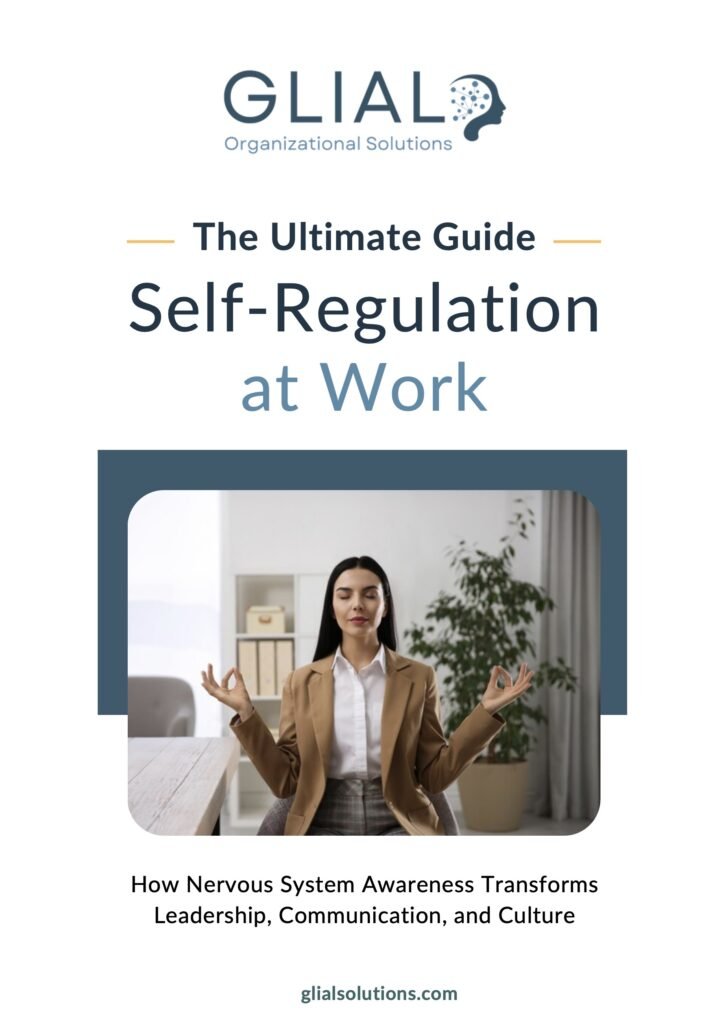


It Doesn’t Start With Strategy — It Starts With the Moment
You’re in a conversation that matters.
A direct report pushes back.
A decision needs to be made quickly.
Something isn’t going according to plan.
You feel it before you think it.
A tightening in your chest.
A sense of urgency.
The impulse to respond — quickly.
This is the moment most leadership advice doesn’t account for.
Because in that moment, leadership is not about strategy.
It’s about self-regulation.
What Self-Regulation in Leadership Actually Means
Self-regulation is often described as emotional control.
But that definition is too shallow to be useful.
Self-regulation is the ability to notice your internal state, your emotional state, your stress response, your impulses, and remain steady enough to choose how you respond.
The autonomic nervous system, the body’s threat detection system, activates quickly in high-stress situations. When it does, it shifts attention toward protection:
- Decision-making becomes reactive
- Emotional responses intensify
- Impulse control weakens
- Communication narrows
This is not a failure of leadership.
It is biology doing its job.
The challenge is that in modern leadership roles, this same response can quietly undermine job performance, relationships, and team outcomes.

Why Self-Regulation Is the Foundation of Effective Leadership
Most leadership development focuses on skills:
Communication
Strategic thinking
Goal setting
Emotional intelligence
But those skills depend on something deeper:
Access.
A leader can know exactly how to respond, and still be unable to access that response in a stressful situation.
This is why self-regulation in leadership is a key component of effective leadership.
It determines whether skills are usable under pressure.
Without it:
- Emotional intelligence drops when it’s needed most
- Self-awareness disappears in the moment
- Leaders react instead of responding
- Teams experience inconsistency
With it:
- Leaders stay calm in high-stress situations
- They manage stress without shutting down or escalating
- They maintain clarity in decision-making
- They support effective collaboration across teams
This is the difference between knowing and leading.
Self-Regulation and Emotional Intelligence
Emotional intelligence depends on self-awareness, the ability to recognize what is happening internally.
But awareness alone is not enough.
A leader can be fully self-aware and still react impulsively.
Self-regulation bridges that gap.
It allows leaders to:
- Recognize emotional patterns early
- Manage their emotions without suppressing them
- Respond intentionally rather than automatically
This is where empathy becomes possible.
When leaders are not consumed by their own internal state, they can accurately read others, support colleagues, and maintain strong relationships, even during increased stress.

What Happens When Leaders Don’t Self-Regulate
The cost is rarely immediate, but it is cumulative.
A sharp response in a meeting.
A decision made too quickly.
An emotional reaction that lingers in the environment.
These moments shape how teams experience leadership.
Over time:
- Psychological safety decreases
- Employees become more cautious
- Open communication narrows
- Trust erodes quietly
Leaders often interpret this as a performance or engagement issue.
But underneath it, there is usually a pattern:
Unregulated moments that compound over time.
The Internal Process of Self-Regulation
Self-regulation is not a single skill. It is a process that happens in real time.
It includes:
Recognizing
Noticing changes in your emotional state, energy, or stress
Pausing
Interrupting automatic reactions before they take over
Regulating
Using the body to stabilize, through breath, posture, or attention
Responding
Choosing behavior aligned with your leadership role and goals
This process happens in seconds.
But it determines the quality of everything that follows.
Practical Self-Regulation Strategies for Leaders
This is not about adding more complexity.
It is about building simple practices that work in the moment.
1. Notice Earlier Than You Think You Need To
Most leaders try to regulate after they are already overwhelmed.
The shift is to recognize signals sooner:
- Increased stress
- Faster thinking
- Urgency in tone
Early awareness increases choice.
2. Use the Body to Stay Calm
Cognitive strategies are limited under stress.
Physiological tools are more reliable.
Deep breathing, slow, controlled breathing, helps regulate the nervous system and reduce activation.
This is not a relaxation technique.
It is a way to stay functional in real time.
3. Create Space Before Responding
Even a brief pause changes the trajectory of a conversation.
A moment of silence.
A slower response.
A question instead of a reaction.
This supports better decision-making and reduces impulsive responses.
4. Track Patterns Through Self-Reflection
Self-reflection improves through awareness over time.
Leaders can reflect on:
- When they tend to react
- What triggers increased stress
- How their responses affect others
This builds self-awareness and strengthens long-term leadership capacity.
5. Restore Energy, Not Just Manage Time
Many leadership challenges are not time problems; they are energy problems.
Without recovery, increased stress becomes the baseline.
Restoring energy through breaks, movement, or stepping away from constant input supports better regulation and more consistent performance.

Self-Regulation and Leadership Style
Leadership style is often discussed as a set of behaviors.
But those behaviors are shaped by internal state.
A leader who is regulated tends to:
- Communicate more clearly
- Stay grounded during challenges
- Support effective collaboration
- Navigate complexity without escalating tension
A leader who is consistently dysregulated may:
- React more quickly
- Struggle with impulse control
- Create unpredictability in the environment
This is why self-regulation has a profound impact on how leadership is experienced, not just how it is defined.
Why This Matters for Teams and Organizational Success
Leadership does not happen in isolation.
Leaders influence the emotional environment of their teams.
When leaders self-regulate:
- Teams feel more stable
- Relationships strengthen
- Communication improves
- Employees feel more supported
This leads to:
- Better job performance
- Stronger collaboration
- More consistent outcomes
Over time, these effects compound into organizational success.
The Part Most Leadership Models Miss
Most models assume that if leaders understand what to do, they will do it.
But in reality, behavior changes under stress.
The gap is not knowledge.
It is access.
Self-regulation closes that gap.
It allows leaders to remain steady, even when conditions are not.
Conclusion: Leadership Is Built in the Moment
Self-regulation is not a soft skill.
It is the foundation that supports every other leadership capability.
It determines:
- How leaders respond under pressure
- How they manage their emotions
- How they influence the people around them
Ultimately, leadership is not defined by what happens in calm conditions.
It is defined in the moments where pressure rises, and the system is tested.
And in those moments, the ability to self-regulate is what makes effective leadership possible.