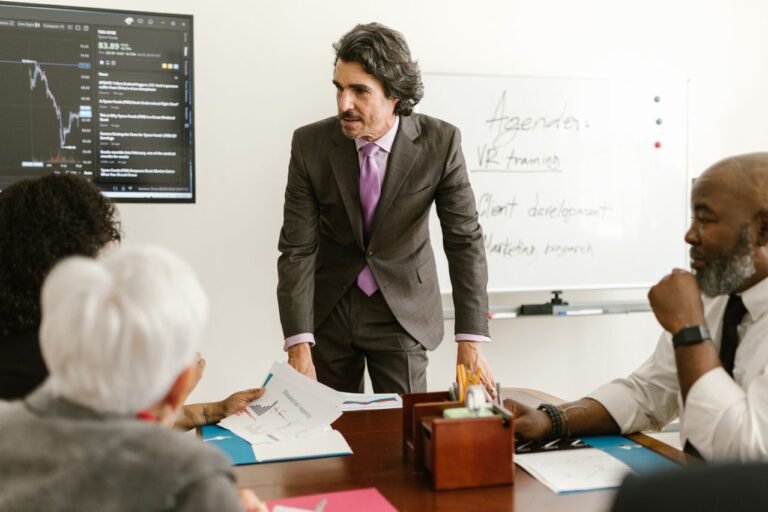


You close your laptop after a full day of meetings. Nothing dramatic happened. Nobody raised their voice. No major conflict surfaced. No crisis unfolded.
And yet, you’re depleted.
Your focus is gone. Your patience is thinner. Small decisions feel strangely difficult. Maybe you need ten minutes of silence before you’re ready to speak to another person.
It’s easy to interpret that exhaustion personally.
Maybe I’m just introverted.
Maybe I’m burned out.
Maybe I’m bad at collaboration.
But there may be another explanation. The meeting may have looked calm on the surface, but your nervous system was working the entire time.
The Work Happening Beneath the Meeting
Meetings are rarely just an exchange of information. While one part of your attention is following the agenda, another may be tracking everything happening around it.
Who seems frustrated? Is this the right moment to speak? How did that feedback land? Is disagreement welcome here? What does my manager think? Did my comment come across the way I intended? Most of this happens without deliberate thought.
The nervous system is constantly taking in social information and trying to determine what requires attention, what feels predictable, and where there may be interpersonal risk. Even in relatively healthy workplaces, this requires energy. This means the meeting your calendar says lasted 60 minutes may have asked much more of you than simply listening and contributing.
Your body may have been trying to manage the room as much as your mind was managing the agenda.
The Exhaustion of Being “On”
For many professionals, meetings also involve a subtle form of continuous self-monitoring. You adjust your tone. Watch your facial expression. Choose your words carefully. Suppress a frustrated response. Try to sound confident without sounding dismissive. Stay engaged when your attention is fading.
Managers may be doing even more, tracking the emotional temperature of the group while simultaneously trying to facilitate discussion, make decisions, support employees, and project steadiness when they may be under pressure themselves. None of these behaviors is inherently unhealthy. Much of it is part of working effectively with other people. But the amount of effort required changes depending on the environment.
When people aren’t sure whether they can ask a question, disagree, admit a mistake, or say “I don’t know” without consequence, more attention goes toward monitoring and protecting themselves. Communication becomes more calculated. People become more guarded. The nervous system stays more vigilant. Nothing dramatic has to happen for that to be exhausting.
Leaders Shape How Much Vigilance a Meeting Requires
A leader doesn’t have to raise their voice to change the nervous system state of a room. People notice pacing. Tone. Consistency. What happens when someone challenges an idea. Whether a mistake is met with curiosity or irritation. Whether the leader’s words and behavior tell the same story.
These cues help people determine how much self-protection the environment requires.
A manager may communicate the correct information and still create uncertainty through abrupt feedback, emotional unpredictability, or dismissive responses. Conversely, a leader who communicates clearly and remains present during disagreement can reduce some of the background vigilance people bring into the interaction. This is where psychological safety becomes more than a leadership concept.
Psychological safety is experienced in repeated moments: whether people can contribute an unfinished idea, ask for clarification, admit uncertainty, or disagree without having to brace for what happens next.
That is why psychological safety leadership training has to go beyond telling leaders to listen better or encourage participation. Leaders also need the capacity to remain steady enough under pressure that openness still feels possible when a conversation becomes difficult. A team learns what is safe not only from what a leader says. It learns from what happens next.
Why Virtual Meetings Can Be Especially Draining
Virtual meetings remove many of the signals we naturally use to understand one another. In person, we take in body language, movement, side interactions, and the broader emotional context of a room. On a screen, much of that information is reduced or fragmented. So the brain has to fill in more gaps.
Was that silence disagreement or a bad connection? Is someone disengaged or simply looking at another monitor? Did that comment land poorly, or is everyone just muted?
Then there’s the unusual experience of watching yourself communicate. For hours at a time, people may be simultaneously participating in a conversation and observing their own face, posture, and reactions on screen. That can add another layer of self-monitoring to an already demanding interaction.
And when one virtual meeting ends, another often begins minutes later. There may be no walk down the hallway, no informal conversation, no quiet transition. The topic changes, the people change, and the nervous system is expected to follow immediately.
The meeting ended. The activation it created may not have.
Some People Carry More of the Room
Meeting exhaustion can be particularly pronounced for people who habitually track the needs and reactions of others.
A highly attuned employee may notice tension before anyone names it. A manager may be listening to one person while simultaneously watching how three others are responding. A leader delivering difficult news may be managing their own reaction while trying to create steadiness for everyone else.
This is part of co-regulation: the way nervous systems influence one another during interaction. That capacity can be a leadership strength. It helps people sense what a room needs, navigate difficult conversations, and maintain connection during uncertainty. But carrying the emotional temperature of every room without enough recovery has a cost.
The same sensitivity that helps someone notice what others need can become exhausting when they feel responsible for managing all of it, which can lead to burnout. So, the answer isn’t to become less emotionally intelligent. It’s to create environments where maintaining connection doesn’t require constant vigilance.
Meetings Become Less Exhausting When Self-Protection Decreases
Most people don’t need every meeting to feel perfectly comfortable. They need to spend less of the meeting protecting themselves.
Clearer expectations help. So do more consistent leadership, fewer unnecessary meetings, room to pause before responding, and communication norms that make disagreement less costly.
At the team level, a psychological safety workshop can help people develop a shared understanding of what creates safety in everyday interactions, not simply as an abstract value, but as something the team practices together.
Recovery matters, too. A few minutes between meetings may seem insignificant, but transitions allow the nervous system to register that one interaction has ended before the next begins. Movement, quiet, stepping outside, or simply spending a few minutes without more input can create some of that space.
The larger point, though, isn’t that employees need another set of techniques for surviving their calendars. Organizations should also be asking what their meeting culture requires of people physiologically. Are employees able to think out loud without over-rehearsing? Can someone disagree without bracing for the response? Do leaders create clarity when uncertainty rises? Is there enough space between interactions for people to recover?
Those questions tell us something a meeting-efficiency metric never will.
The Meeting Wasn’t “Just a Meeting”
If you leave a seemingly ordinary meeting feeling depleted, that exhaustion doesn’t necessarily mean you’re bad at collaboration or incapable of handling your workload. Your nervous system may have spent the last hour interpreting social cues, managing your own responses, tracking the reactions of others, and determining how safe it was to participate.
That is a lot of extra work. And when it happens- meeting after meeting, day after day- the cost accumulates. This is why nervous-system-informed leadership asks a different question.
Not simply: Did we communicate the information?
But: What did people have to do internally in order to participate in that conversation?
Because the healthiest, most productive meetings aren’t necessarily the ones without tension, disagreement, or difficult decisions. They’re the ones where people can stay connected to themselves and one another without spending the entire conversation protecting themselves.