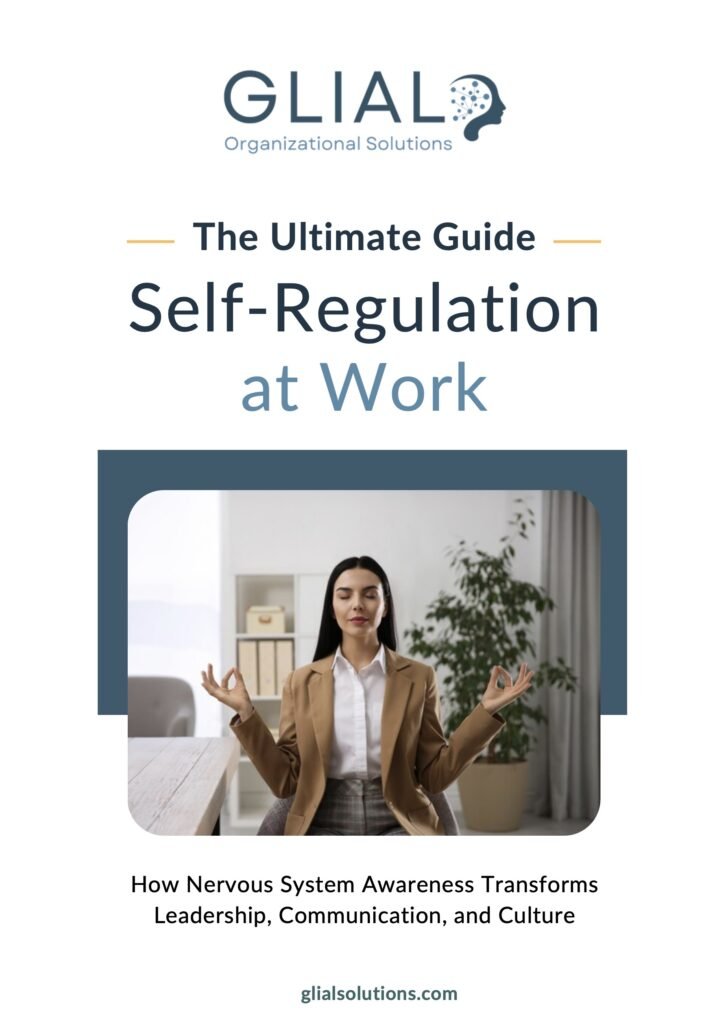
Most organizations treat workplace stress as a mental health issue or a time management problem. They invest in wellness apps, mindfulness programs, and work-life balance initiatives, yet burnout remains high, and team performance continues to decline under pressure.
The reason is simple: stress is not just a mental challenge. It is a physiological state.
At Glial Solutions, we provide a stress management workshop for employees that addresses the biological root of performance. By focusing on nervous system regulation, we help teams move beyond “coping” with stress and toward maintaining clarity, focus, and effective communication, even when the stakes are high.


Why Workplace Stress Undermines Performance
When we talk about workplace stress, we are describing the body’s response to a perceived threat. In a modern professional environment, that threat isn’t a predator; it’s a looming deadline, digital overload, unclear roles, or interpersonal conflict.
While the source of the pressure is professional, the response is physical. This physiological shift has immediate and measurable effects on organizational performance:
- Attention narrows: The ability to think strategically or find creative solutions decreases.
- Decision-making declines: Reactive impulses replace thoughtful analysis.
- Communication becomes reactive: Small misunderstandings escalate quickly into workplace conflict.
- Collaboration breaks down: Teamwork becomes more difficult as the social engagement system becomes less accessible.
Workplace stress management training that ignores this physiological reality is merely asking people to “think differently” while their bodies are signaling danger. To truly manage stress, we must first address the stress response at its source.

If This Feels Familiar, You’re Not Alone
Many leadership teams and HR directors notice a recurring pattern where employees feel overwhelmed despite existing support. You might see:
- High performers are beginning to disengage or lose their usual spark.
- Teams are losing focus and becoming disorganized during high-pressure periods.
- A decline in employee morale despite “culture-building” efforts.
- Increased anxiety and physical symptoms of exhaustion across the department.
- Valuable workers are leaving the company due to burnout.
These are not signs of a “weak” workforce or a lack of resilience. These are signs of a nervous system and an entire organization under sustained load. This is why employee stress management training must go deeper than surface-level habits.
Why Traditional Stress Management Training Falls Short
Most companies approach employee mental health through the lens of relaxation. They offer mindfulness programs, yoga, or advice on work-life balance. While these have value for personal life, they often fail to translate to the heat of a difficult meeting or a 2:00 PM deadline.
Traditional training falls short because it asks employees to wait until they get home to practice recovery. Glial’s stress management workshop is different. We don’t teach people how to relax away from work; we teach them how to stay regulated while they work.

A Different Approach: Regulation-First Performance
Most stress management programs teach people how to achieve a state of calm. Glial teaches people how to achieve a state of resilience. This approach is grounded in applied neuroscience and designed specifically for high-performance work environments.
Our stress management workshop for employees is a form of workplace stress management training built on the premise that a regulated nervous system is the foundation of all other professional skills. Whether it’s leadership, innovation, or productivity, your ability to access these skills is determined by your internal state.
The Science of Stress and Performance
To effectively manage stress, participants must understand the autonomic nervous system. This system acts as the body’s surveillance department, constantly scanning the workplace for cues of safety or threat.
- The Stress Response: When the system detects a threat, it triggers a “fight or flight” response. Heart rate increases, and blood flows away from the prefrontal cortex—the part of the brain responsible for logic and innovation.
- Impact on Cognition: In this state, your employees cannot focus on complex tasks. They become defensive and lose their flexibility.
- The Recovery Gap: If workers never learn how to signal “safety” to their nervous system, they stay in a state of chronic stress. This is the primary driver of burnout.
We present these concepts in a way that is accessible and immediately applicable. We don’t just talk about the science; we use it to create a positive workplace culture where stress levels are managed in real-time. This supports long-term leadership resilience across the entire organization.
The Regulation-First Model
Our workshop focuses on three distinct levels of regulation:
Self-Regulation
Employees learn to identify their own stress triggers and recognize when they are becoming reactive. This is the same foundation developed in our somatic leadership training program.
Co-Regulation
In a team environment, stress is contagious. But so is stability. We teach managers and employees how to function like "glial cells", supporting the nervous systems of those around them. This creates the conditions for psychological safety across teams.
Organizational Regulation
We discuss how the organization itself can influence stress levels through meeting structures, communication flows, and how the company handles a break or transition.
Stress Management Skills Employees Still Need
While we focus on physiology, we understand that regulation is the engine that powers essential professional outcomes:
- Communication under pressure: Staying steady during a challenge.
- Conflict management: Resolving issues without emotional escalation.
- Focus and productivity: Maintaining deep work despite distractions.
- Adaptability: Navigating organizational change with resilience.
- Emotional intelligence: Understanding the emotional factors that contribute to team dynamics.
What Happens During the Workshop?
This is an experiential stress reduction workshop designed to engage every person in the room. Each activity is designed to simulate real workplace conditions, ensuring stress management skills transfer into daily performance.
During the workshop, participants will:
- Participate in stress awareness exercises to map their own stress response.
- Practice guided breathing and grounding techniques that can be used discreetly at a desk.
- Work through real-world workplace scenarios to practice co-regulation.
Develop a personal recovery plan to prevent burnout.
Workshop Delivery Options
We offer flexible delivery to meet the needs of diverse companies:
- In-person workshops: High-impact, two-hour or half-day sessions for up to 40 participants.
- Virtual sessions: Interactive digital training for remote or hybrid teams.
Cohort-based learning: Deep-dive programs that build resilience over time.
Measurement and Outcomes
We believe workplace stress training should produce a measurable influence on the organization. We use pre/post self-assessments and team feedback to track:
- Improved focus and productivity during high-pressure work
- Reduced reports of workplace stress and burnout
- Clearer communication and fewer conflict escalations
- Higher employee engagement and team cohesion

Who This Workshop Is For
This course is designed for organizations that value both performance and people. It is ideal for:
- Employees are facing high-volume workloads or rapid organizational change.
- Leadership teams must stay steady while making high-stakes decisions.
- HR and L&D leaders are looking for a science-based alternative to standard wellness programs.
Why Organizations Choose Glial
Glial Solutions is the leader in nervous-system-informed organizational consulting. Our work is grounded in applied neuroscience, somatic practice, and real-world organizational consulting experience with teams operating under sustained pressure.
We don’t offer generic advice. We offer a foundation for sustainable performance. By helping your workers achieve regulation, you are building a more resilient, productive, and innovative organization.
Explore how regulation-first stress management training can strengthen your organization’s performance.